

In this guide
Start with exposure. Then specify the casting.
For 304 vs 316 stainless steel investment casting, the main selection question is corrosion exposure. The molybdenum-bearing 316 family offers improved resistance to chloride-related localized corrosion compared with 304. It is not a guarantee against seawater corrosion. Nickel Institute’s material guidance explains the distinction.
Before requesting a price, define the environment, applicable casting grade, machined features, finish and inspection requirements. A short alloy label alone does not describe a finished component.
304 vs 316 casting: a practical comparison
| Decision point | 304 family | 316 family |
|---|---|---|
| Starting point | Consider for suitably mild service conditions. | Consider when improved chloride resistance is required. |
| Cast grade terminology | CF8 is a commonly referenced cast counterpart. | CF8M is a commonly referenced cast counterpart. |
| Finish and fit | Specify visible surfaces and functional dimensions separately from the alloy. | |
| Quotation comparison | Request the same quantity, drawing revision, machining scope and inspection scope. | |
| Approval | Confirm the material standard and application requirements before production. | |
Selection starting points, not universal service limits. Cast-grade terminology is discussed below.
What will the component actually encounter?
“Indoor,” “outdoor” and “marine” are useful labels, but they leave important questions unanswered. Include the exposure and cleaning conditions in the enquiry instead of expecting a supplier to infer them from the part name.
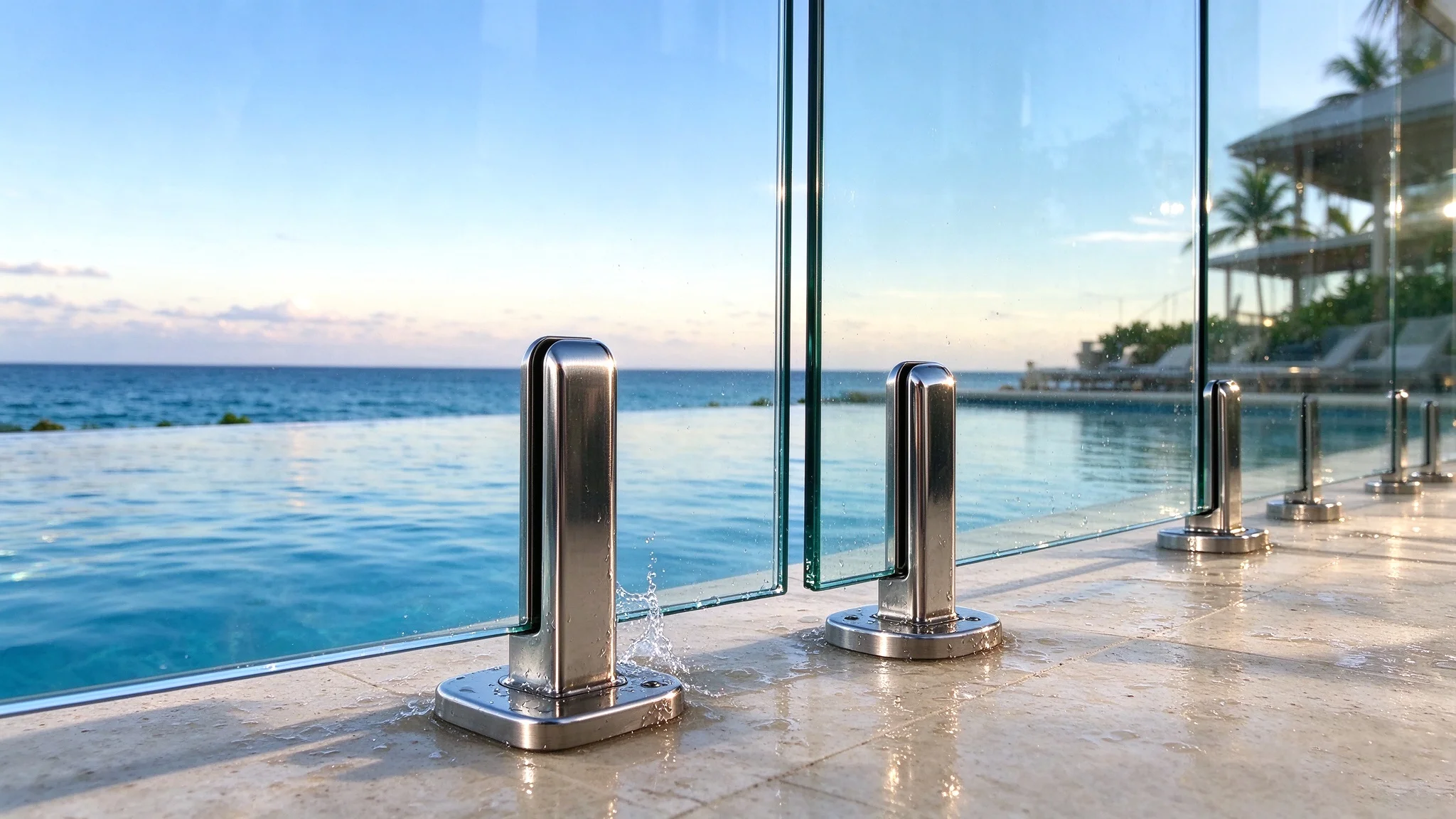
316 stainless steel glass railing hardware — consider exposure and cleaning access.
Architectural hardware
For a bracket, glass fitting or door component, describe the installation location, weather exposure, cleaning products and appearance requirements. Mark surfaces that will remain visible after installation.
Explore architectural hardware ↗
316 stainless steel marine hardware — define the service conditions for each part.
Marine hardware
Distinguish a deck fitting from a continuously immersed component. Record salt exposure, temperature, drainage and cleaning access. “Marine grade” should not replace a defined material specification.
Explore marine hardware ↗Neither 304 nor 316 should be assumed suitable for every chloride environment. Temperature and crevices matter, and more highly alloyed materials may be needed. Outokumpu’s corrosion guide is useful background for discussing these risks with the responsible materials engineer.
Application illustrations of 316 stainless steel hardware. Material selection and installation requirements must be reviewed for each project; these images are not structural-design approvals.
CF8 and CF8M: do not stop at “304” or “316”
Buyers often use 304 and 316 as familiar family names. For a casting, CF8 and CF8M are commonly referenced counterparts; CF3 and CF3M are associated with the low-carbon families. JC Casting’s grade overview illustrates these naming relationships.
Counterpart does not mean that every requirement is interchangeable. Put the applicable casting standard, grade and required condition on the drawing or purchase specification. Ask the supplier to flag discrepancies before tooling approval.
A useful enquiry might state: “Please confirm the appropriate casting specification for this application and identify any deviation from our drawing.” This is clearer than silently substituting a grade because its name looks similar.
Plan machining and finishing at the same time
Alloy selection is only one part of purchasing a usable component. Identify the dimensions that control assembly, the surfaces that need machining and the areas where appearance matters. Do not apply one tight tolerance indiscriminately to every surface.
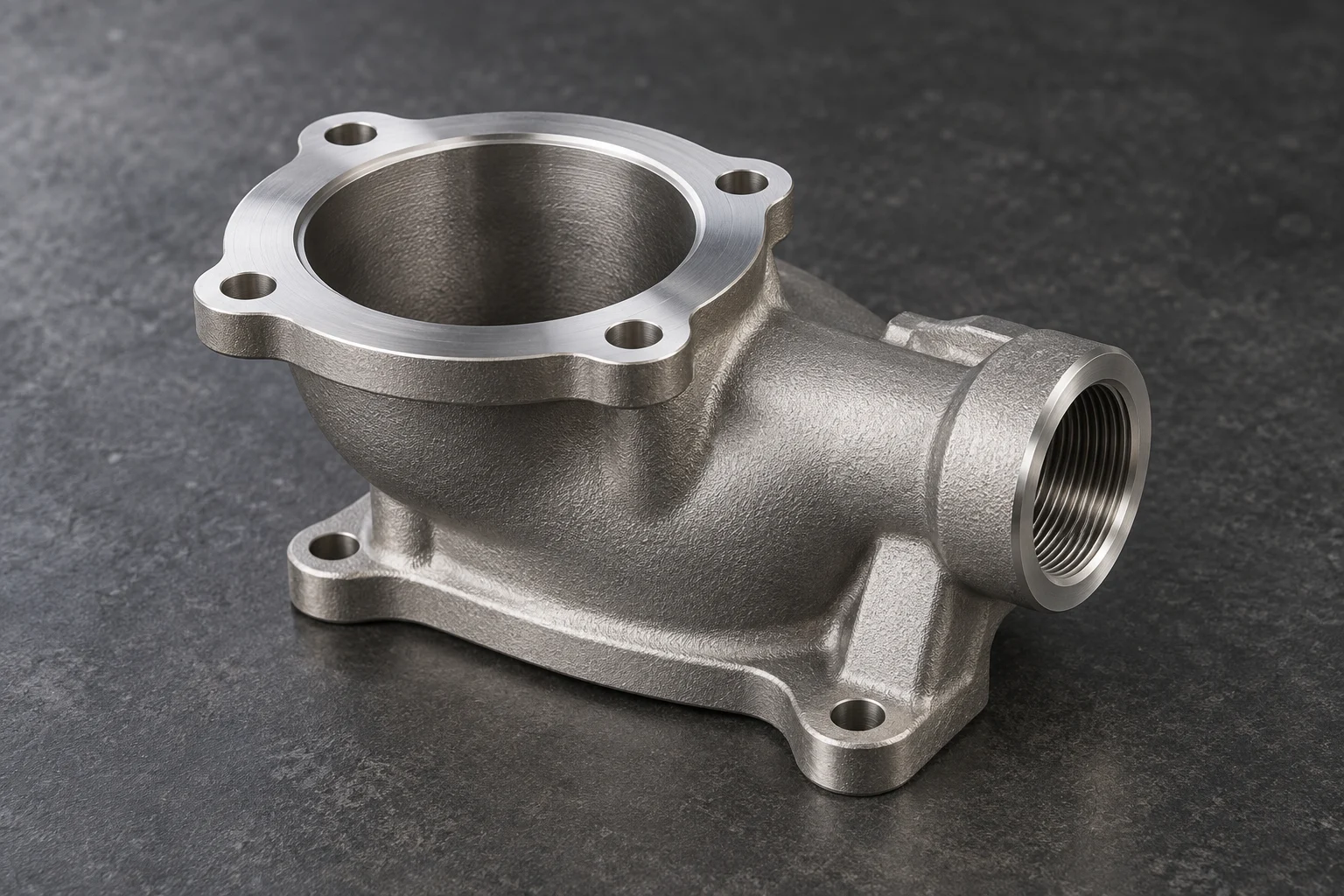
- Machining: identify threads, mating faces, bores and reference datums.
- Appearance: provide a finish sample or measurable requirement, not only “high polish.”
- Surface treatment: specify any required cleaning, passivation or other treatment and its acceptance criteria.
- Inspection: agree which dimensions and material records must accompany the shipment.
Connect the casting drawing to the CNC machining requirements and surface-finishing scope before comparing quotations.
Which option offers better value?
A material price comparison is not a finished-part cost comparison. Ask for quotations against the same deliverable: an inspected component with the required machining, finish and documentation. Keep tooling charges, recurring part prices and any inspection costs identifiable.
If both material options remain technically acceptable, request a like-for-like comparison. If one option does not meet the service requirement, a lower unit price is not a useful saving. There is no universal percentage premium that can replace a current quotation for your drawing and volume.
Your stainless steel casting RFQ checklist
- Drawing and model: send the current 2D drawing and available STEP model, with revision identification.
- Application: describe exposure, operating conditions and the component’s function.
- Material: state the required standard and grade, or mark selection as awaiting engineering review.
- Quantity: separate sample quantity, order quantity and estimated annual demand.
- Finished condition: identify machining, visible surfaces and any additional treatment.
- Acceptance: list dimensional inspection, material documentation and any application-specific tests.
For supporting material pages, see 304 stainless steel casting and 316 stainless steel casting. Keep the approved project specification as the controlling document.
Frequently asked questions
Is 316 always better than 304 for investment casting?
No. Select against the required environment and performance. An alloy upgrade does not remove the need to define geometry, finishing and inspection.
Does 316 mean a component is seawater-proof?
No. A material family name is not a service guarantee. Have the responsible engineer evaluate the actual exposure, including temperature and crevices.
Can I specify only “stainless steel” on the drawing?
That leaves the material open to interpretation. Identify the applicable standard and grade, or explicitly request a material-selection discussion before quotation approval.
Should I compare prices before defining CNC operations?
Define the finished-part scope first. Otherwise, one quote may cover a raw casting while another includes machining and inspection.
Discuss your stainless steel casting project
Send your drawing, quantity and service conditions to toway casting. Include the required machining and finish so the enquiry describes the part you need to receive.
Prepare your quote request ↗This guide provides general purchasing information, not a material approval or structural design specification. Confirm application suitability with your responsible engineer.